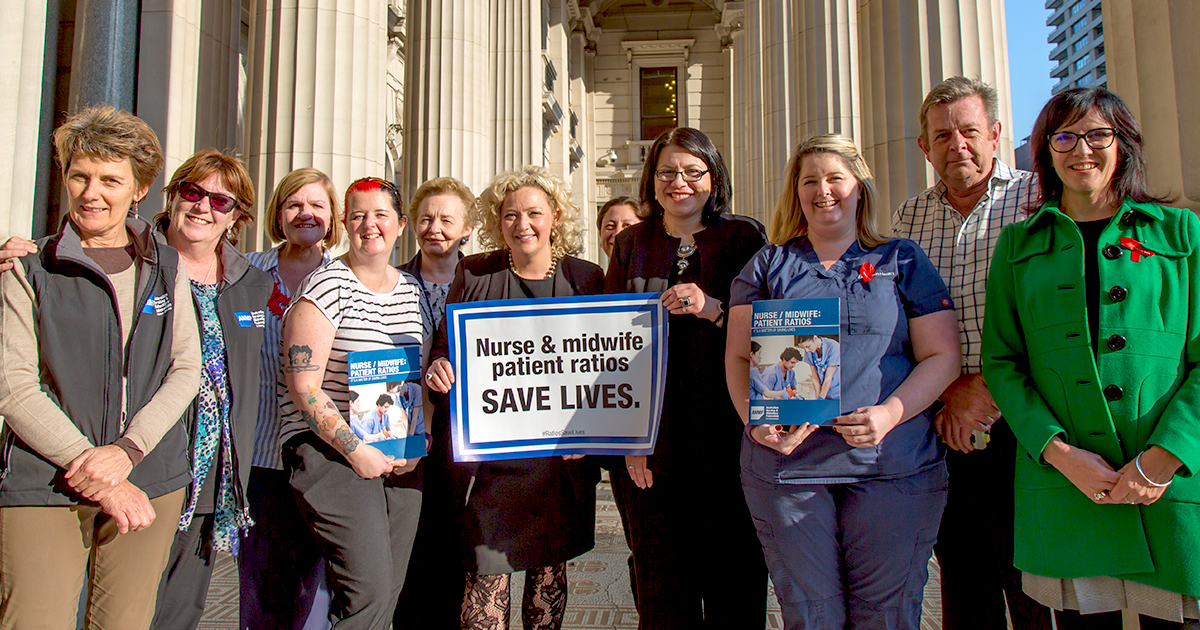
In one of the most significant uplifts to nurse/midwife-to-patient ratios in 25 years, the Allan Government has announced it will introduce legislation that will improve ratios across 26 Victorian public hospitals including in emergency, ICU and medical and surgical wards.
The Hospital Reclassification Review Bill will be introduced in July and will see 26 public hospitals reclassified in the Safe Patient Care Act resulting in ratio improvements.
Seventeen of the hospitals are in regional Victoria.
Nurses and midwives working in the 26 hospitals will be able to provide more comprehensive nursing/midwifery care because they will have the time to spend with their patients and families.
Improving ratios and working conditions will improve recruitment and retention at these health services where nurses have been under significant pressure because of the current ratios.
Premier Jacinta Allan first made the announcement at ANMF’s 2026 Delegates Conference followed by a media conference with the Premier and Health Minister Harriet Shing at ANMF on 28 June.

Premier Jacinta Allan and Health Minister Harriet Shing at the public hospital reclassification review legislation announcement
Years of advocacy by ANMF and its members
This Bill is the culmination of many years of ANMF members’ advocacy, including via motions at the Annual Delegates Conferences, for a transparent and evidence-based review of the methodology to determine the classification of hospital levels in Schedule 1 (medical/surgical wards and ICUs) and Schedule 3 (emergency departments) to ensure they are responsive to increases in demand.
As part of its 2018 election commitments, the Andrews Labor Government promised to review hospital levels and emergency department levels within the Act. The classification review is the first since ratios were achieved in the 2000 enterprise agreement and then legislated in the Safe Patient Care Act in 2015. Warrnambool Base Hospital is the only hospital reclassified in 25 years. It moved from a level 3 to a level 2 hospital in 2022.
Hospital levels and the Safe Patient Care Act 2015
Public hospitals in Victoria are grouped into three schedules in the Safe Patient Care Act:
- Schedule 1: level 1, 2 and 3 hospitals
- Schedule 2: hospitals not restricted in use of enrolled nurses
- Schedule 3: categories of hospitals for emergency departments
A hospital’s classification determines the ratios required at that hospital. For example:
| Medical/surgical ratios | |||
| Hospital level | AM | PM | night |
| Schedule 1, Level 1 hospital | 1:4, plus a nurse in charge | 1:4, plus a nurse in charge | 1:8, plus a nurse in charge |
| Schedule 1, Level 2 hospital | 1:4, plus a nurse in charge | 1:5, plus a nurse in charge | 1:8 plus a nurse in charge |
| Schedule 1, Level 3 | 1:5, plus a nurse in charge | 1:6, plus a nurse in charge | 1:10 plus a nurse in charge |
| Schedule 1, Level 4 | 1:6, plus a nurse in charge | 1:7, plus a nurse in charge | 1:10 |
New methodology to classify hospitals
This Bill will enact the inaugural review which has classified public hospitals on public data from the Victorian Agency for Health Information. This means improved transparency for members on their hospital’s demand, capacity and subsequent classification.
The Branch also sought additional weighting for regional hospitals to address the additional complexity in regional services with regards to access and resourcing. This was done via the MMM weighting system – or the Modified Monash Model used by the Commonwealth Government to better target health workforce programs to attract health professionals to more remote and smaller communities.
ANMF has secured a commitment from the Allan Labor Government that no hospital will go down a level as a result of this legislation. The government has also committed to include urgent care centre data as part of the future review scheduled for 2029.
Read the Department of Health’s ‘Hospital classification review algorithms’ document.
What services will change?
Schedule 1, level 1
Classification as a level 1 hospital under Schedule 1 of the Act will require:
- hospital bed days greater than 100,000; or
- hospital bed days greater than 50,000 and ED presentations greater than 70,000 and ICU average hours of care greater than 140 or your NICU/special care admissions are greater than 500 or your maternity capability level is five or six.
Based on these thresholds, there are currently eight level 2 services that will move up to become level 1 services:
- Bendigo Hospital
- Ballarat Health
- Maroondah Hospital
- Werribee Mercy
- Goulburn Valley Health
- Latrobe Regional Hospital
- The Royal Women’s Hospital
- Mercy for Women.
Schedule 1, level 2
Classification as a level 2 hospital under Schedule 1 of the Act will require:
- hospital bed days greater than 25,000 and ED presentations between 20,000 and 69,999 OR the ICU average daily hours of care greater than 100 or your NICU/special care nursery admissions are greater than 350 or your maternity capability level is four or five.
Based on these thresholds, there are 12 hospitals that move to a level 2:
- Angliss Hospital
- Albury Wodonga Health, Wodonga Campus
- Rosebud Hospital
- Bairnsdale Regional Health Service
- Echuca Regional Health
- Sale Hospital
- Wimmera Hospital (please note: the previously stated West Wimmera Health Service was incorrect)
- West Gippsland Healthcare Group
- Wonthaggi Hospital
- Sandringham Hospital
- Victoria Heart Hospital
- The Royal Victorian Eye and Ear Hospital.
Schedule 1, level 3
Classification as a level 3 hospital under Schedule 1 of the Act will require:
- hospital bed days greater than 15,000 AND the hospital has an urgent care centre.
Based on these thresholds, there are three level 4 hospitals that are expected to become level 3 hospitals:
- Colac Area Health
- Maryborough District hospital
- Ararat Hospital.
Schedule 3, emergency departments
Schedule 3 of the Act classifies hospitals into part 1, part 2 and part 3 emergency departments. Following implementation of the review, the algorithm threshold for part 1 will be ED presentations of 35,000 or more.
Based on this threshold, three hospitals will move from their current Part 2 classification to a Part 1 classification:
- Northeast Health Wangaratta
- Echuca Regional Health
- Royal Victorian Eye and Ear Hospital.
The algorithm threshold for part 2 will be ED presentations between 20,000 and 34,999. This threshold will see five hospitals move from their current Part 3 classification to a Part 2 classification. These are:
- Royal Women’s Hospital
- Sale Hospital (Central Gippsland)
- West Gippsland Hospital
- Swan Hill District Health
- Wonthaggi (Bass Coast Coast Health).
Finally, the algorithm threshold for part 3 will be ED presentations lower than 20,000. Three hospitals will move from Part 4 classification to Part 3 classification:
- Victorian Heart Hospital
- Mercy Hospital for Women
- Hamilton Base Hospital.
ANMF will keep members informed about the implementation of this much needed legislation.
Ratios are not set and forget
The ANMF achieved nurse/midwife-to-patient ratios in the public sector enterprise agreement in 2000. We were the second place in the world after California to secure ratios as a mechanism for staffing hospitals. We were the first in the world to implement ratios in 2001; California implemented ratios in 2004.
ANMF members spent more than a decade fighting to save and improve ratios, particularly in the 2011-12 EBA when the Baillieu/Napthine Liberal Victorian government attempted to substitute nurses and midwives with health assistants. The Andrews Government implemented its 2014 election commitment to enshrine the ratios in the EBA into legislation with the Safe Patient Care Act 2015.
The Labor Victorian Government has amended the Act three times, which led to three tranches of improved and new ratios. There were two concurrent rounds of improvements between 2019 and 2022. The current round of improvements must be fully implemented by 1 July 2026.
This reclassification legislation will be the fourth amendment to the Safe Patient Care Act.
ANMF will continue to advocate for future improvements to ratios based on outcomes of members meetings and motions passed at the Annual Delegates Conference.
Edited: this article originally stated the new bill would enshrine the new methodology in law. This was incorrect.