Federal ANMF is calling for the introduction of ratios in private and not-for-profit residential aged care to address chronic understaffing, increasing workplace violence and a lack of financial accountability for Federal Government funding worth more than $25 billion each year.
Victoria’s public aged care facilities have had ratios since 2001.
While ANMF previously campaigned nationally for mandated minimum aged care ratios, the union ultimately supported the aged care royal commission’s 2021 recommendation to introduce mandatory daily average care minutes.
This was because care minutes promised better staffing than the vague requirements of the Aged Care Act 1997. Between 1997 and 2023, providers were able to roster an undefined ‘adequate number of appropriately skilled staff’. This allowed providers to determine their own staffing levels.
Mandatory care minutes have been in place since October 2023 as part of the new Aged Care Act 2024, however more than a third of providers do not meet the care minute minimum. The latest Federal Department of Health, Disability and Ageing quarterly care minutes report (January-March 2026) found that 40 per cent of 2560 facilities did not meet the total daily average care minutes or the required daily average registered nurse care minutes.
The ANMF’s renewed national call for ratios is in response to the growing concerns from our members in aged care and the results of the national survey of nurses and personal care workers which was released in August.
More than 3500 nurses and carers participated in the ‘Aged Care Pulse Check – The Real Impact of Reforms’. More than half of participants were from Victoria.
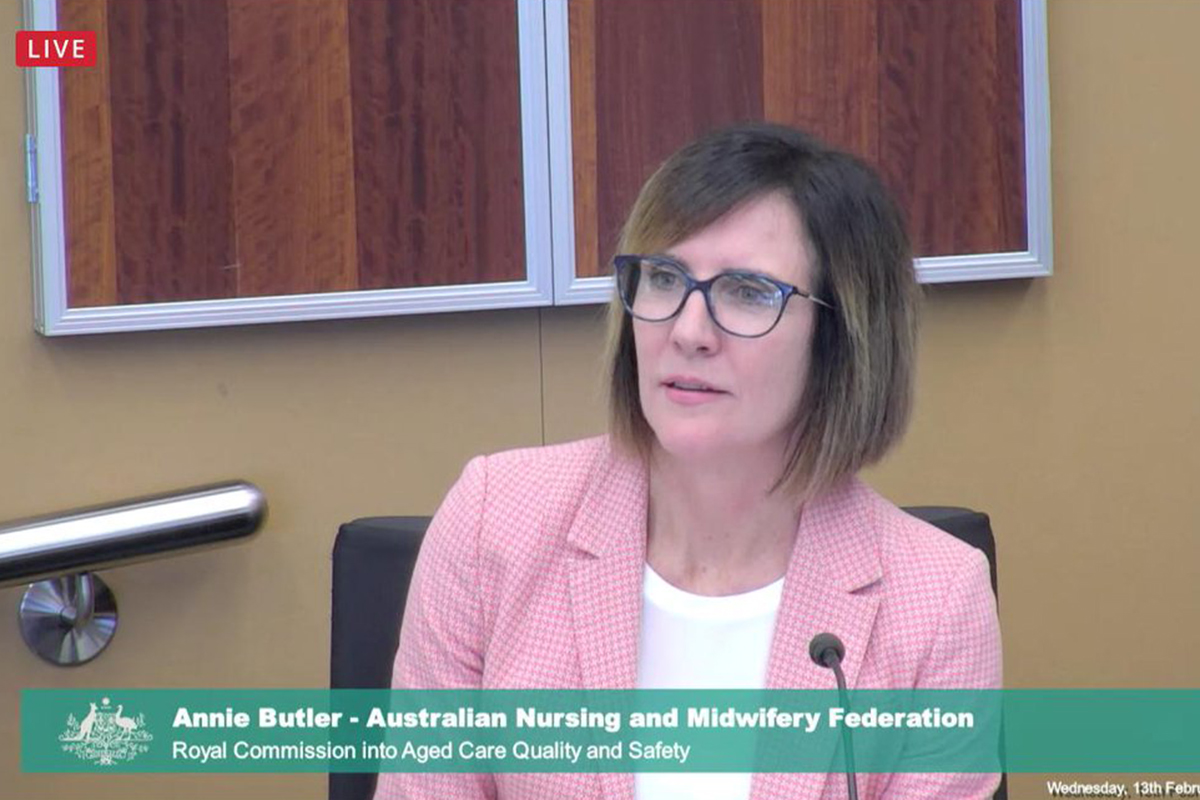
ANMF Federal Secretary Annie Butler said the survey revealed a ‘damning assessment of the aged care sector’ and demonstrated the aged care royal commission reforms implemented by the Albanese Government had not solved the sector’s problems.
Key findings of the national ‘Aged Care Pulse Check – The Real Impact of Reforms’ survey
Inadequate staffing and skills mix
- Almost half (49.03%) of the staff surveyed had insufficient time to deliver care, increasing to 55.75% for staff from for-profit providers
- 47.52% of all respondents said the ratio of nursing staff to care staff was inadequate, increasing to 52.09% in for-profit providers
- Nearly two in five respondents (39.71%) rated the level of staffing at their workplace as ‘inadequate’, ‘poor’ or ‘very poor’
- 43.47% of those working in private for-profits providers were more likely to rate the staffing levels as inadequate.
Escalation of workplace violence and aggression
- Almost all staff (96.43%) experienced and/or observed one or more instances of violence and aggression at their workplace in the past 12 months. Most identified residents as the source of occupational violence and aggression:
- 20.22% of staff said a lack of funding/budget meant residents didn’t receive the services they need, 35.74% of those staff said it happens ‘some of the time’, whilst 20.22% indicated it happens ‘most of the time’
- 69.68% experienced physical violence
- 49.01% reported property damage or thrown objects
- 36.44% experienced racism
- 35.55% experienced sexual harassment.
Workers who rated the overall level of staffing at their workplace as ‘very poor’ were more likely to report experiencing violence and aggression, suggesting that inadequate staffing levels contribute directly to the likelihood of experiencing it.
Cost-cutting and lack of financial transparency
The Federal Government provides the residential aged care sector more than $25 billion each year.
- 22% of staff said a lack of funding/budget meant residents didn’t receive the services they need, 35.74% of those staff said it happens ‘some of the time’, whilst 20.22% indicated it happens ‘most of the time’
- Staff reported providers frequently failed to replace sick staff or hire agency workers, which was perceived as a measure to control costs
- Other cost-saving measures included rationing essential supplies such as wound dressings or updating equipment.
Key recommendations
The national ANMF survey report made 15 recommendations that will inform an upcoming member campaign. These include:
- replacing care minutes for residents with mandated staffing ratios that are aligned with evidence-based benchmarks
- introducing mandatory, standardised risk assessment and person-centred care planning to prevent and manage workplace violence and aggression
- strengthening workplace violence incidence reporting systems, including mandated reporting and systems that ensure transparency and accountability for how providers respond to incidents
- introducing nationally consistent, competency-based workforce training on violence prevention and management
- developing and implementing a staged de-privatisation strategy to reduce for-profit ownership of aged care services and expand public and not-for-profit services
- legislating transparent, standardised public reporting of provider financial performance and use of government funding
- strengthening the role, resourcing and enforcement powers of the aged care regulator to ensure providers’ compliance and accountability of public funding.
Read the ‘Aged Care Pulse Check – The Real Impact of Reforms’ full report
ANMF (Vic Branch) aged care members’ experience
ANMF (Vic Branch) Secretary Maddy Harradence said ‘The sector was grappling with systemic understaffing, violence and funding transparency before the introduction of mandatory care minutes, and after two years sadly that has not dramatically changed.
‘The greatest challenge for a nurse or a personal care worker is when they’re not able to provide the care residents need because there are not enough staff,’ she said.
‘When our aged care members raise staffing issues and excessive workloads, we are finding care minutes are not visible on a shift-to-shift basis and they’re very difficult to monitor because they are measured and averaged over a three-month period,’ Ms Harradence said.
‘We don’t have that issue when reviewing a roster in a public hospital or public aged care facility because we know how many nurses must be rostered on each shift.
She said Victoria’s 25-year experience of ratios in public hospitals and 159 public aged care facilities showed ratios improved patient and resident care and importantly prevented understaffing.