Members will likely be aware that as part of the Victorian government’s climate change strategy it has banned gas connections in new houses and hospitals and has implemented several other incentives to encourage Victorians to make the transition to all-electric housing.
With evidence overwhelmingly suggesting that a gas-free future is a healthier, cheaper, safer future, ANMF (Vic Branch) welcomes moves that support Victorian homes and hospitals to get off gas. The Branch joins Victorian Trades Hall Council, Environment Victoria and the Victorian Council of Social Services in supporting electrification and ending our state’s reliance on gas.
In our submission to the 2022 Engage Victoria consultation for Victoria’s Emissions Reduction Target for 2035, we called for 100 per cent renewable electricity for public hospitals and gas-free hospital builds. In a more recent submission, we have called for fossil fuel subsidies to be redirected into electrification initiatives, and funding pilots for health services currently on gas to transition to electricity.
‘From respiratory conditions and heat-related illness to the many physical and psychosocial health implications of natural disasters, our members see the threat to human health from climate change every day.’
‘From respiratory conditions and heat-related illness to the many physical and psychosocial health implications of natural disasters, our members see the threat to human health from climate change every day,’ said ANMF (Vic Branch) Acting Secretary Madeleine Harradence.
‘We know this is important to nurses, midwives and carers. At the Branch’s 2024 Delegates Conference, ANMF Job Reps and HSRs supported a resolution to advocate for the establishment of government programs to fund cooling and heating systems, as well as other upgrades, to the homes of community members vulnerable to heat stress.
‘While ANMF works with government and industry on big-picture climate challenges, we also acknowledge that more immediate solutions are required. Low-income households and renters would be amongst those significantly benefiting from cheaper energy and predictable bills, but the upfront costs of electrification can be beyond the average household budget. Vulnerable members of our community must also be supported to transition into a renewable energy future with access to affordable and safe heating and cooling.’
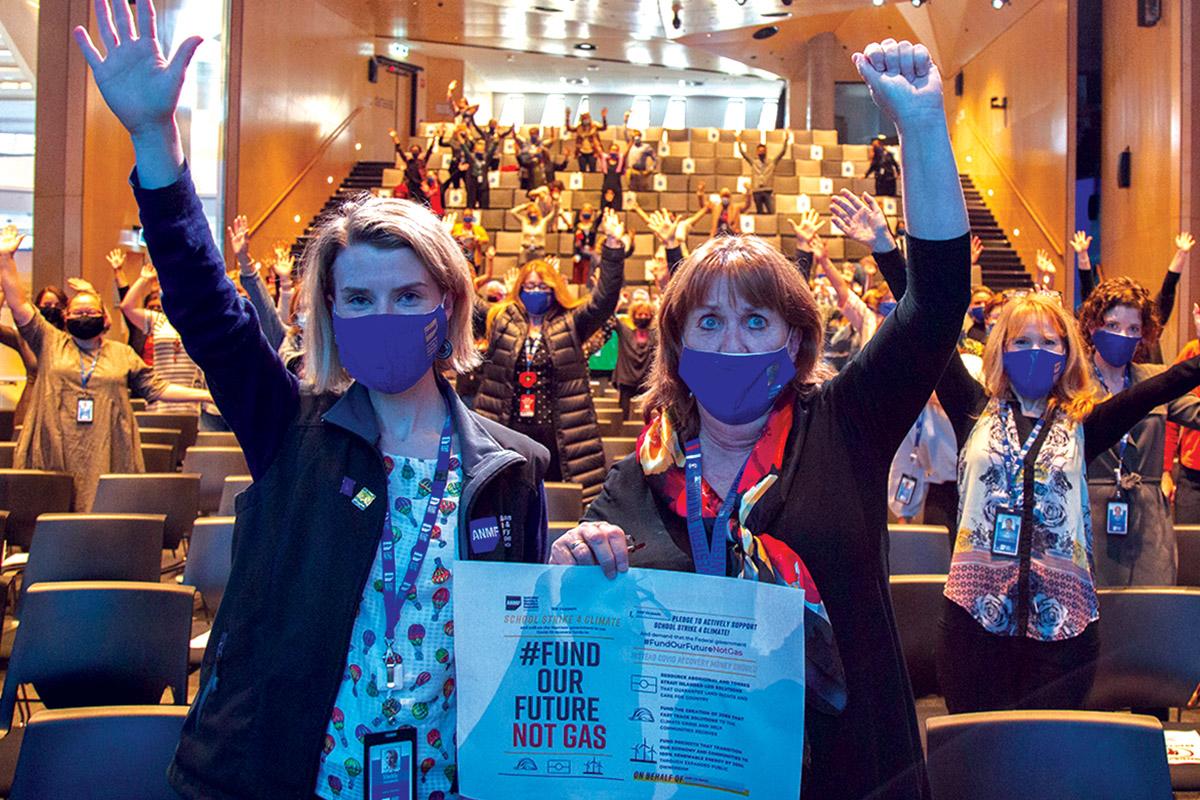
ANMF (Vic Branch) Assistant Secretary Maddy Harradence and Secretary Lisa Fitzpatrick show support for the School Strike 4 Climate’s ‘Fund our future, not gas’ campaign in 2021
Why get off gas?
There are many compelling reasons to get off gas, from cost-of-living to well-documented climate change impacts, but increasingly the human health implications are being highlighted.
Health reasons
Recently, researchers at Stanford University have published the results of a study in the Journal of Hazardous Materials (volume 492, July 2025) which found that homes with medium to high usage of gas stoves/cooktops and inadequate ventilation had a ‘significantly elevated’ risk of benzene-related cancer, especially for children.
Ventilation mitigated risks, they added, but the study underscores the importance of addressing combustion-related indoor air pollutants.
There is also evidence that gas stoves and cooktops increase the risk of asthma. The Climate Council’s Kicking the Gas Habit: How Gas is Harming Our Health notes that ‘a child living with gas cooking in the home faces a comparable risk of asthma to a child living with household cigarette smoke.’
Like the Stanford researchers, the Climate Council report notes that ‘better ventilation, including modern extraction fans over stoves, flues for gas heaters and other safety measures like ensuring appliances are properly serviced or opening windows can reduce – but not eliminate – these risks.’
So for households not yet able to switch off gas, the recommendation is to open windows and use high-quality vent hoods whenever possible when cooking.
Cost-of-living reasons
Cost of living is a significant issue for members, as well as those they care for.
Victoria is getting more of its electricity from renewable sources, while the cost of gas is going up. This is partly because Victoria is running out of gas. Explaining Victoria’s energy challenge, the Grattan Institute reports that the Gippsland Basin, which has been a key source of oil and gas for more than 50 years, is running out. ‘Depletion of that resource was forecast early this century, and now the depletion is accelerating.’
Pipeline capacity to bring gas from other states is limited, the report notes, ‘and proposed facilities to bring LNG into the south-east have failed either to get commercial sales arrangements in place or to secure regulatory approvals. The result is that south-eastern Australia, markedly Victoria, faces the risk of gas shortfalls in coming years.’
The Australia Institute warns that the gas industry is using this to drive a scare campaign for gas expansion when new gas will only expand exports, which drives up domestic gas prices. The International Energy Agency makes it clear that to reach net zero emissions by mid-century and limit catastrophic climate change there should be no new oil, coal or gas projects built.
More tangibly, switching from gas to electricity can immediately eliminate your gas connection fee and thus lower your energy bills by reducing duplication in service fees. Many electric appliances are also significantly more energy efficient than their gas counterparts.
What can you do right now?
Check out the Victorian Energy Upgrades program, which provides discounts and benefits to Victorian homeowners and renters looking to make the switch to more energy-efficient electric appliances – including heating and cooling, hot-water systems, induction cooktops, and water-efficient shower heads.
Can’t switch to electricity yet, but want a more ethical gas provider? CoPower has been providing members with not-for-profit electricity for several years, and now also offers gas. ANMF Victoria is a member of CoPower and welcomes their announcement that profits from gas sales will go to initiatives to assist customer members to reduce their energy use and, where possible, to transition away from gas.