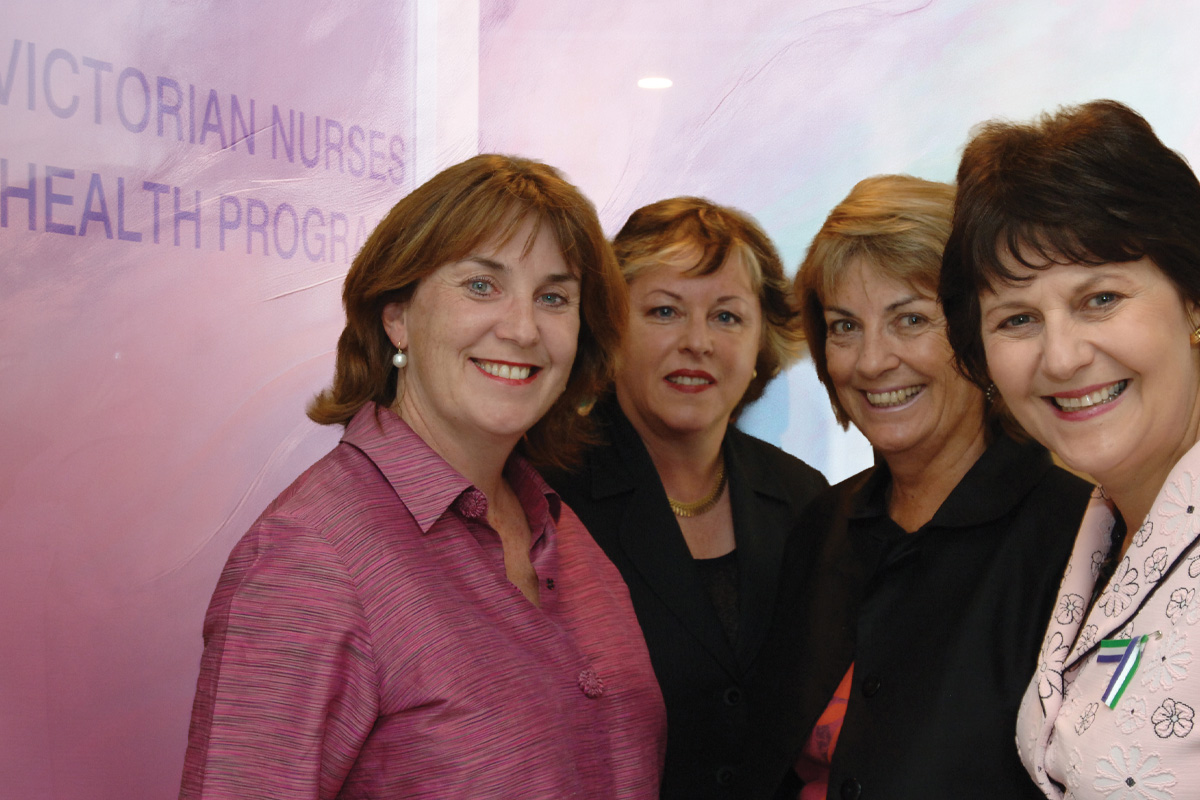
Launching the Victorian Nurses Health Program in 2006. Left to right: ANF (Vic Branch) Secretary Lisa Fitzpatrick, Nurses Board of Victoria Chief Executive Officer Louise Milne-Roch, Victorian Nurse Health Program Chairperson Belinda Morieson and Victorian Health Minister Bronwyn Pike. Photo: Les O’Rourke.
‘I’ve been working in drug and alcohol services for 12 years and one of the things I always hear is that the system is a nightmare to navigate.’
That was Heather Pickard, addressing Job Reps at the 2006 ANF[1] (Vic Branch) Delegates Conference. Heather, a registered nurse, was the founding director of the Victorian Nurses Health Program (VNHP), a groundbreaking service established to enable nurses (and midwives) with an alcohol or drug abuse issue to seek free, independent and confidential support without risking their registration, job or career.
Specifically, Heather was referring to the drug and alcohol system being a nightmare for nurses and midwives to navigate, something she also had personal experience with after struggling with alcohol misuse in her early career.
The incidence of drug and alcohol abuse experienced by nurses and midwives is no higher than in the general population – about ten per cent – but prior to 2006 nurses and midwives were unable to freely
seek help from a doctor or emergency department because doing so risked them being reported under the Medical Practice Act 1994.
This punitive approach was intended to protect patients but as it encouraged nurses and midwives to hide their problems rather than seek help, in effect it put patients, residents and clients at risk, as well as harming staff.
An Australian first
Announced by ANF (Vic Branch) Secretary Lisa Fitzpatrick in April 2006, the VNHP was designed to fix this.
‘In an Australian first, Victorian nurses will be able to refer themselves to the Victorian Nurses Health Program for discreet and compassionate health services,’ Lisa said.
‘I became very excited about the potential of such a program after speaking with Dr Taffy Jones who established a similar program [for doctors] in 2001, which encouraged a culture of self-referral and helped save the careers of hundreds of doctors while at the same time protecting patients,’ Lisa added.
Working with Heather Pickard, ANF industrial officer (and later assistant secretary) Yvonne Chaperon and the Nurses Board of Victoria[2], Lisa spearheaded the service to support and protect nurses’, midwives’ and subsequently patients’ lives.
‘The VNHP means nurses will be able to seek confidential help before their lives and/or careers are destroyed,’ she said. ‘As we all know, nursing can be a very stressful profession. It is fantastic to see such an innovative health program intended to support, assist and rehabilitate nurses.’
While there were programs overseas with similar aims, the Victorian model was the first of its kind in Australia, if not the world. ‘It was revolutionary in Australia,’ Heather recalls. ‘There were programs overseas but they were often 12-step, total-abstinence based, which works for some people but was not the model we wanted to set up here. Not everybody can go into rehab for three months. We needed something different for our environment.’
Immediate success
The Victorian Nurses Health Program was initially funded through nurses’ and midwives’ state registration fees.
Lisa Fitzpatrick’s predecessor as ANF (Vic Branch) Secretary, Belinda Moreison, was appointed to chair the program, while Heather Pickard resigned from the founding committee in order to apply for the director position. ‘I was doing the job description and realised: oh my god, I’m going to have to step back from this working group because I want to go for it!’
It was successful almost immediately. ‘We kept a lot of nurses in work, safely,’ Heather recalls. ‘ANF would manage the industrial issues, and we would manage the health issues. It was a really well-functioning team.’
De-identified participant feedback speaks to this success: ‘I just wanted to thank-you for supporting me when I felt so overwhelmed. [This support] started me on a path towards healing. I am deeply grateful for the way you helped me take this first step on the journey.’
In 2008, Glenn Taylor joined as CEO. By then, the service had already recognised that alcohol and drug challenges were part of the larger psychological health concerns that Victoria’s nurses and midwives faced.
‘We’re not talking significant diagnoseable injury or disease or illness,’ Glenn told ANMF in 2024. ‘We’re talking about everyday matters like stress, exposure to vicarious trauma, abuse, working antisocial hours – typical stuff confronted by nurses and midwives.’
So the program’s scope broadened to encompass not just alcohol and drug abuse matters and related mental health issues but any and all health and wellbeing concerns – including family violence.
A registered nurse with a background in the mental health and AOD spaces, Glenn led the organisation over the next decade and half, navigating it through existential funding hurdles, the pandemic and its recent national expansion.
Funding frustrations
The first hurdle occurred in 2010 with the move to national nursing and midwifery registration and the end of the Nurses Board of Victoria, which had until then funded the service [Heather notes that the Board’s CEO, Louise Milne-Roch, had been so supportive of the program that she even funded their original office furnishings out of her own pocket].
After successful lobbying from ANF, then Victorian health minister Daniel Andrews secured Nurses Board of Victoria assets, worth $1.6 million, to fund the program until June 2013 during the transition to national registration.
In 2012, despite increasing nurses’ and midwives’ registration fees by 40 per cent and commissioning an independent report that had supported the ‘quality, effectiveness and value of the NMHPV’s work’, the new Nursing and Midwifery Board of Australia (NMBA) declined to confirm either a hoped-for national expansion or ongoing funding of the state program – now named the Nursing and Midwifery Health Service Victoria (NMHPV).
In response, ANMF filed a Freedom of Information application into the Board’s rationale and also launched an online petition. More than 5000 Victorian nurses and midwives signed, helping to secure a temporary reprieve from the NMBA, which agreed to fund the program for 12 months.
Further advocacy and lobbying from ANMF and members eventually convinced the Board to extend this temporary funding from June 2014 until June 2016, but as that deadline drew closer it pulled the plug on any further extensions – despite NMHPV’s continued operational success.
However, following the publication of academic research that found suicide rates among nurses and midwives to be higher than other occupations, in late 2016 – on the NMHPV’s 10th anniversary – the Andrews state government recognised the service’s critical lifesaving work with a commitment to fund it long-term.
Indeed, realising the significance of its investment the government soon established a similar service for child protection practitioners, the Child Protection Health Program Victoria, based on the model and success of the NMHPV.
[1] The Australian Nursing Federation’s Victorian Branch added Midwifery to our name in 2013
[2] The state-based predecessor to the Nursing and Midwifery Board of Australia